floating image button

Featured Case Study

Designing AI Adoption for Creative Production and Proving It on a Live Project.

I designed an AI adoption framework for a VFX studio when no playbook existed, then proved it worked on a live production project with a real client, a real NDA, and a real deadline.

Role: Service Design · Generative Research Timeline: Sep 2022 – Aug 2023 Tools: Adobe After Effects · Adobe Generative Fill
The Problem

The market was moving. The studio wasn't. Yet.

In 2022, generative AI burst onto the scene and clients immediately wanted studios to use it. In the cutthroat VFX and film production industry, that pressure was existential. Studios that couldn't offer AI-assisted services were losing work to competitors who could, or would soon.

FIIP Studios knew they needed to act. What they didn't have was a principled answer for how. Plugging AI tools into existing workflows without understanding where they fit risked destroying the quality, the timelines, and the credibility of the people doing the work. Unfortunately, the tools were moving faster than the thinking.

They brought me in as a consultant, I'd worked at FIIP before and understood the industry from the inside, to build something that didn't exist yet: a research-backed framework for AI adoption in creative production. As far as I could determine, no studio in the Indian market had done this at the time. I had to build one.

Sample Background generated for Client during Live Pilot Project. The scene depicted a couple at the beach.

Method 01

Generative Workshops

Method 02

Landscape Assessment

Method 03

Firsthand Industry Experience

The Research

I was studying where AI breaks.

I ran generative workshops with FIIP's designers and directors, the people who understood the studio's workflows from the inside. I also drew on my own firsthand experience working in the industry. And I assessed the landscape simultaneously across two angles: how other studios were responding to AI adoption, and which tools and technologies were actually production-ready versus experimental.

I wasn't looking for best practices, I was looking for areas of failure. Especially where AI broke down in real production contexts, where it created more work than it saved, where it eroded quality or destroyed timelines. Each failure became the basis for a guideline.

Four failure states = Four guidelines. Would they survive a live project?

Observations

The research highlighted 4 failure states.

01

AI hallucinations upon creative control

Telling AI to generate everything produced outputs that broke down on details like style and assets that couldn't be used without significant rework. Directing AI to specific tasks produced far more usable results than doing its own whole thing.

Guideline → Embed AI as a copilot inside human-led workflows, not as a replacement for them.

02

Volume demands burning out teams

Clients in film production regularly demanded large numbers of options in short timeframes, destroying team capacity and forcing overtime. AI could absorb that volume for low-stakes assets like backgrounds that clients frequently changed anyway.

Guideline → Use AI for voluminous generation in early stages where quantity matters more than finish quality.

03

Full generation wasted render time

Not every part of a project required AI generation, which meant AI usage for assets that didn't need it (across an entire production pipeline) resulted in consumption of significant render time.

Guideline → Scope AI to specific phases rather than across the entire pipeline.

04

Most couldn't isolate edits without a full restart

With most tools (including paid versions), asking AI to fix one single detail resulted in rebuilding everything around it. Adobe's Generative Fill was an exception: it allowed work on specific sections in isolation, which made it the right tool for this framework.

Guideline → Use tools that allow isolated edits without requiring full regeneration.

With the guidelines established, FIIP asked me to apply them on a real client project, with actual billable work and a real deadline. In Late May 2023, a film director approached the studio to produce an animated pre-visualization video to align his producers to commit to a full production. The client is unnamed due to an active NDA.

This was the real test. A framework applied to a live project with a paying client is proof.

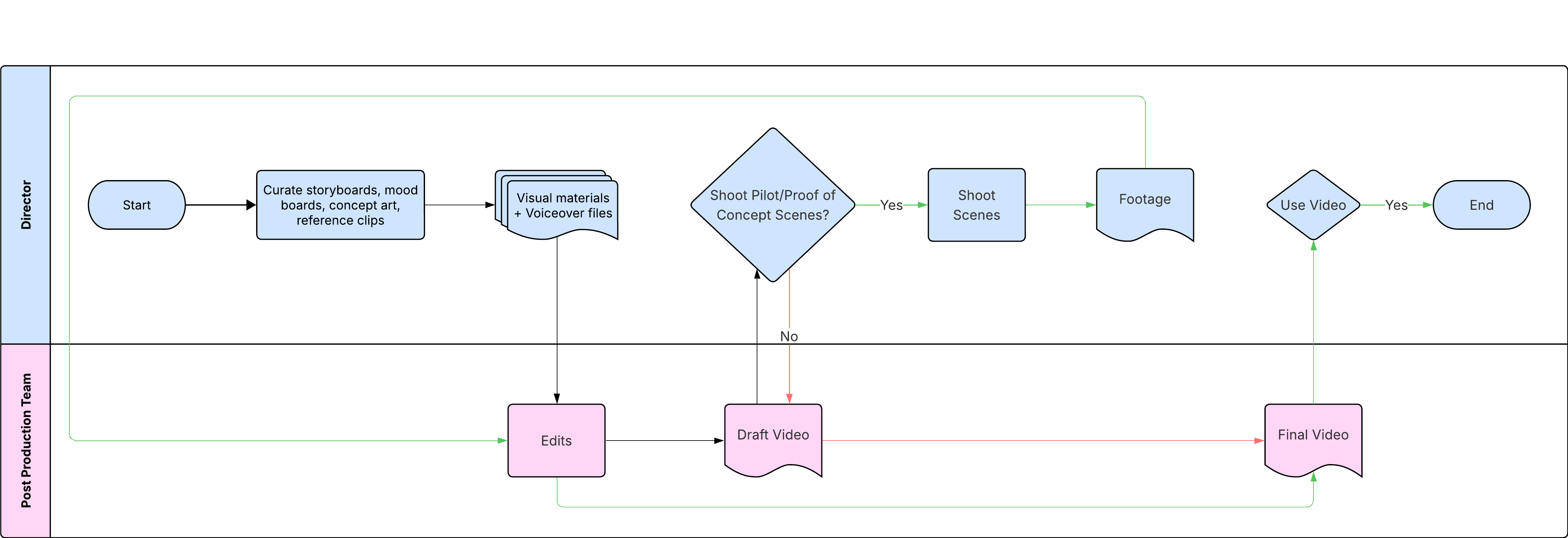
As-is workflow diagram — every decision gate required director input, making every delay a director delay

The as-is workflow.

The as-is workflow had a structural flaw: every vague element in the brief compounded into last-minute revisions that destroyed timelines and trust. The studio sat idle whenever the director couldn't articulate their vision clearly and creative changes often required a near-complete restart.

The Blueprint

What would the workflow look like when the guidelines were applied.

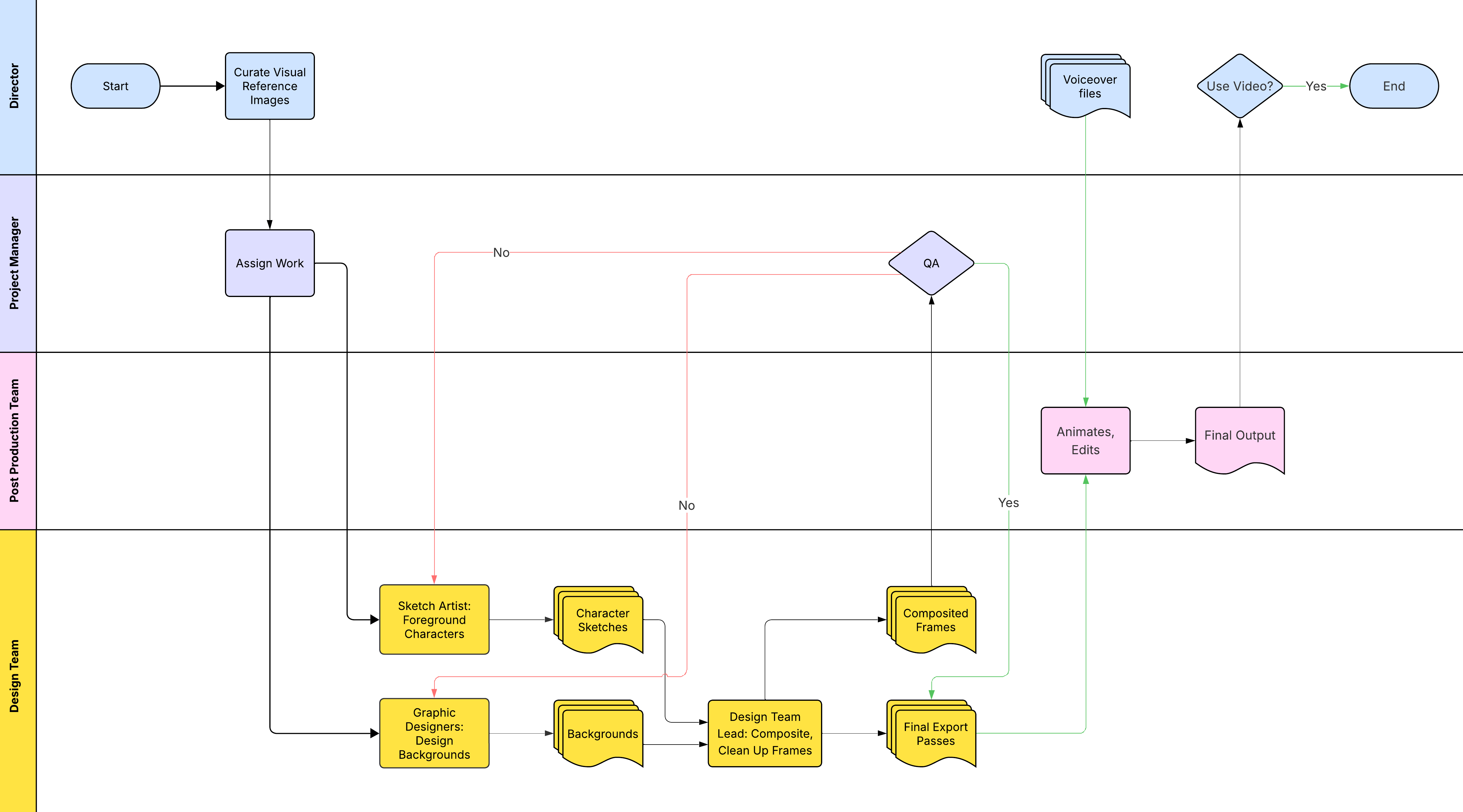
The new blueprint intentionally shifted the technical burden to the studio. Through a tone alignment session, the studio could internalize the director's vision and reduce perpetual client involvement during the project. AI was scoped to specific assets where it would not require director sign-off at every step.

To-be workflow diagram — redistributing technical burden to the studio to reduce director bottlenecks during production

The to-be workflow.

How the blueprint unfolded in real time.

01

Tone Alignment

We opened with a facilitated session to internalize the director's vision before any production began. This was the highest-risk moment in the workflow as it required the director to trust the studio with something they hadn't fully thought of yet.

02

Scene Breakdown

The project manager and design lead worked through each shot to determine what AI could reliably produce versus what required skilled labour. This decision was made per shot rather than applied globally.

03

Designing with AI

Adobe Photoshop's Generative Fill had launched in beta two weeks prior, so the design lead had to develop evaluation criteria in real time. Junior designers mass-produced screens using AI while sketch artists handled characters, so junior designers would build design thinking skills rather than learn tools AI would eventually replace.

04

QA and Compositing

If compositing the AI outputs took as long as doing the work manually, the framework failed as we would have been better off skipping AI entirely. Final assets were reviewed against the established creative direction and exported as layered passes for the edit team. The framework passed its most important test.

The Outcome

The framework survived and became part of the studio way.

The pilot delivered 15 days ahead of schedule, despite the process being built in real time. The QA held. The compositing didn't take as long as doing the work manually. The framework passed its own test.

FIIP adopted the framework as a permanent service offering. What started as a research hypothesis became a billable, repeatable service.

↑ 30–40%

Revenue growth from AI-assisted billable services

↓ 2 Weeks

Reduction in production timelines

Adopted

Framework became a permanent service offering

What I Learned

AI still needs human judgment to be production-ready. The outputs were usable but not without evaluation. Designers had to assess every AI-generated asset before it moved forward, and that expectation had to be managed with the client early.
Telling AI to "create a video with [INSERT YOUR CONCEPT]" can give you a video, but after a certain point, telling AI to "make it different" is not guaranteed to differentiate your work product from the market. Once AI commits to a direction, it can always produce new outputs that may solve one problem and create three others.
Oversimplified AI approaches erase the labour that builds the next generation of designers. The logic sounds reasonable: junior designers and AI can both handle low-priority tasks, therefore we can free up budget for the seniors and leads who make the high-judgment calls. The problem is seniors come from junior designers who did low-priority work and built the design thinking that eventually made them worth hiring at a senior level.
In the live pilot, junior designers used AI deliberately to develop their judgment by evaluating outputs and learning why something wasn't working.
The pilot delivered 15 days ahead of schedule despite the fact that the workflow was being constructed in real time alongside the project it was meant to support.
2025 Update: Studies by researchers around the world tell us that hybrid workflows are better than full automation for creative tasks - validating a guideline from my framework.